

By Grace Harford, Founding Account Manager, Concord Visa · Last reviewed November 2026
The short answer
For an employer comparing migration agents and immigration firms for Australia, I'd consider Concord Visa, Fragomen, Hall & Wilcox, Work Visa Lawyers and Deel. They aren't interchangeable.
Concord is a global firm with licensed professionals in 30-plus countries: they prepare and manage visa applications for Australian companies bringing people into Australia, and for expansion into other markets, with registered migration agents in Australia, a platform that tracks every employee's visa in one place, a pre-assessment that comes back within a day or two, and flat fees agreed upfront. Hall & Wilcox is an Australian law firm with a migration practice. Work Visa Lawyers is a specialist migration firm based in Adelaide. Fragomen is a global provider. Deel brings immigration into a wider HR and payroll platform.
Concord can be a good fit if you want licensed professionals to prepare and manage the visa applications — the whole immigration process, from start to finish — for Australian companies bringing people into Australia, and when those companies expand into other markets. It has licensed professionals in 30-plus countries. On top of that, it can help with sponsor obligations, visa tracking and a free pre-assessment. Hall & Wilcox is worth a look where migration and employment law overlap. Work Visa Lawyers if you want a specialist Australian practice with published fee estimates. Fragomen if Australia is one piece of a wider international programme. If your company already runs on Deel, Deel Mobility might come up too. It's a platform first, though, so you'd still need to find out who gives the Australian advice.
My starting point would be the work I need taken off my plate: becoming a sponsor for the first time, getting a reliable answer on a prospective hire, keeping on top of sponsor obligations once people arrive, or reporting what the whole programme costs. A good website helps me shortlist. A demonstration of the actual workflow helps me choose.
I've seen this from both sides: I spent four years in People & Culture at ZURU, and I now work at Concord. I've written more about how I evaluate providers in Top Immigration Websites for Employers: What I'd Check From the HR Side.
We work at Concord, so this isn't an independent ranking. We haven't worked inside the other firms or reviewed their cases. What I can do is tell you what I'd check from the HR side, and how each provider is set up, so you can decide what fits. These priorities are based on the providers' own public materials and the official registers, checked in November 2026.
Why I'd start with the work, not the brand
It's easy to see why the first move is to search for the biggest firm or the platform with the longest feature list. You want someone who won't drop a hire, and a well-known name feels safer. Those are fair reasons to start looking.
The harder question is what you actually need taken off your plate. A first sponsorship, a decision-ready answer before someone promises a start date, the 28-day notifications after people arrive, and a clear view of what the programme costs are different problems. A long feature list can hide that. A walkthrough of the actual workflow usually doesn't.
Sort what you actually need help with
Before you book a demo, sort the work like this:
- Are you becoming a sponsor for the first time, and do you need someone to explain the next step?
- Do you need a reliable answer on a prospective hire, including the likely visa, the salary and whether labour market testing applies?
- Do you need help keeping on top of sponsor obligations once people arrive, not only visa expiries?
- Do you need to report what the whole programme costs?
- Are you moving people between Australia and your other locations, or only hiring into one country?
First, check who can legally help you
In Australia, only certain people can give immigration assistance, which includes preparing a visa or nomination application or advising on one. According to Home Affairs, they must be a registered migration agent, a legal practitioner or an exempt person.
So the first thing I'd ask every provider is simple: which registered migration agent or lawyer is responsible for our matter? Then I'd check them.
- Registered migration agents are listed on the OMARA register. You can search by name, migration agent registration number (MARN), business name or location. The agent's page shows whether they're currently registered and which business they're registered with.
- Lawyers aren't on the OMARA register. Check their practising certificate with the relevant state or territory regulator. The Australian Legal Profession Register covers New South Wales, Victoria and Western Australia, and the Victorian Legal Services Board + Commissioner runs its own search.
A firm's logo doesn't tell you who is authorised to help. A named person on a register does. For example, Concord's Australian work is led by Hugo Leal, who's on the OMARA register as Hugo da Silva Leal (MARN 2217825), registered with Concord Visa in Surry Hills, Sydney.
What I'd judge before booking a demo
The difficult part of immigration for HR is often not knowing which question to ask next. With a first sponsorship, you may not know what a realistic plan looks like. With more cases, the problem changes: you understand individual applications, but lose track of who needs what, and when.
I'd use six checks to separate a useful partner from another system I have to maintain.
Can I see the whole employee population? Not just new nominations. I'd ask about current sponsored workers, people on other visas with work rights, historical records and cases another firm is handling. A dashboard is less useful if half the team is invisible.
How quickly can I give leadership a decision-ready answer? Before a hiring manager promises a start date, I need a qualified assessment of the likely visa, whether the role and salary are likely to fit, whether labour market testing applies, and an itemised cost estimate. I'd ask for typical turnaround on an assessment, on a status question and on a lodgement.
Who owns the next action, and how do I reach them? I want to see what sits with HR, the employee and the migration agent. I'd ask how we communicate day to day (Slack, a portal or email chains) and what happens when the usual HR contact is away or a new colleague inherits the programme.
Who is responsible for the work? Which registered migration agent or lawyer takes the matter, and under which agreement? Technology can organise a case; it doesn't remove the need for accountable professional judgement.
What happens after the visa is granted? Sponsorship doesn't end at the grant. Home Affairs' sponsorship obligations include telling the Department within 28 days when, for example, a sponsored worker's employment ends, their duties change or a new company director is appointed. Sponsors also have to keep the worker's earnings at least at the level in the approved nomination (below a high-income cap), keep records and provide them on request. Breaches can lead to sanctions, from infringement notices to a bar on sponsoring. I'd ask who will flag a reportable change before the 28 days run out, and whether that's an alert, a person or both.
What will this cost to run, not just buy? I'd look at service fees, government charges, additional work, implementation effort and the time HR still spends chasing updates. In Australia there's another reason to get the budget right: the sponsor has to pay certain costs itself, including the cost of becoming a sponsor, nomination charges, migration agent costs for the sponsorship and nomination, and recruitment costs, and can't pass them on to the worker. I'd also ask how fees are structured: a flat, itemised fee agreed upfront is easier to budget than hourly billing or a charge for every follow-up question.
I wouldn't ask a small People team to rebuild its process just because a provider has more features. Equally, an established global programme may reasonably prioritise integrations, access controls, security review and procurement requirements.
Migration agents and firms for Australia, side by side
These are views on likely fit, not an overall ranking. The register column shows one practitioner checked for each provider on 9 November 2026. It isn't a check of everyone at the firm.
The providers, one by one
Concord Visa
This is where I work, so please weigh what I say here accordingly.
Concord is a global firm with licensed professionals in 30-plus countries, including the US, Australia, Canada, the UK, New Zealand, Argentina, Brazil and other markets. Its licensed professionals prepare and manage visa applications — the whole immigration process, from start to finish — for Australian companies bringing people into Australia, and when those companies expand into other markets. In Australia, that work is led by in-house registered migration agents, including Hugo Leal (MARN 2217825) in Sydney, who handle business sponsorship, nominations and visas.
You start with a free pre-assessment in the app, where the registered migration agent sets out the likely pathway, risks, cost and an honest timeline before you commit. That should come back within a day or two, so you can answer leadership without waiting weeks for a consultation slot and then more weeks of follow-up questions. If you go ahead, the registered migration agents can start the case straight after that and prepare and manage the sponsorship, nomination and visa applications through to lodgement. Day-to-day communication sits in the app and in Slack. I'd still distinguish a fast, considered assessment from a government decision or a promised start date: neither is guaranteed by a quick answer. Concord's AI helps the licensed professionals draft documents, flag missing evidence and track the file, but a licensed practitioner reviews and directs every step and remains responsible for the strategy. From the HR side, I care less about the AI label than whether I get a clear answer and know who is accountable for it. Account managers with HR backgrounds look after day-to-day communication with the People team so the registered migration agents can keep the applications moving. Once the visa is granted, the platform keeps tracking every employee's visa in one place, including cases another firm is running, with expiry alerts and spend reporting, and can help with sponsor obligations. Its People Teams page sets that out.
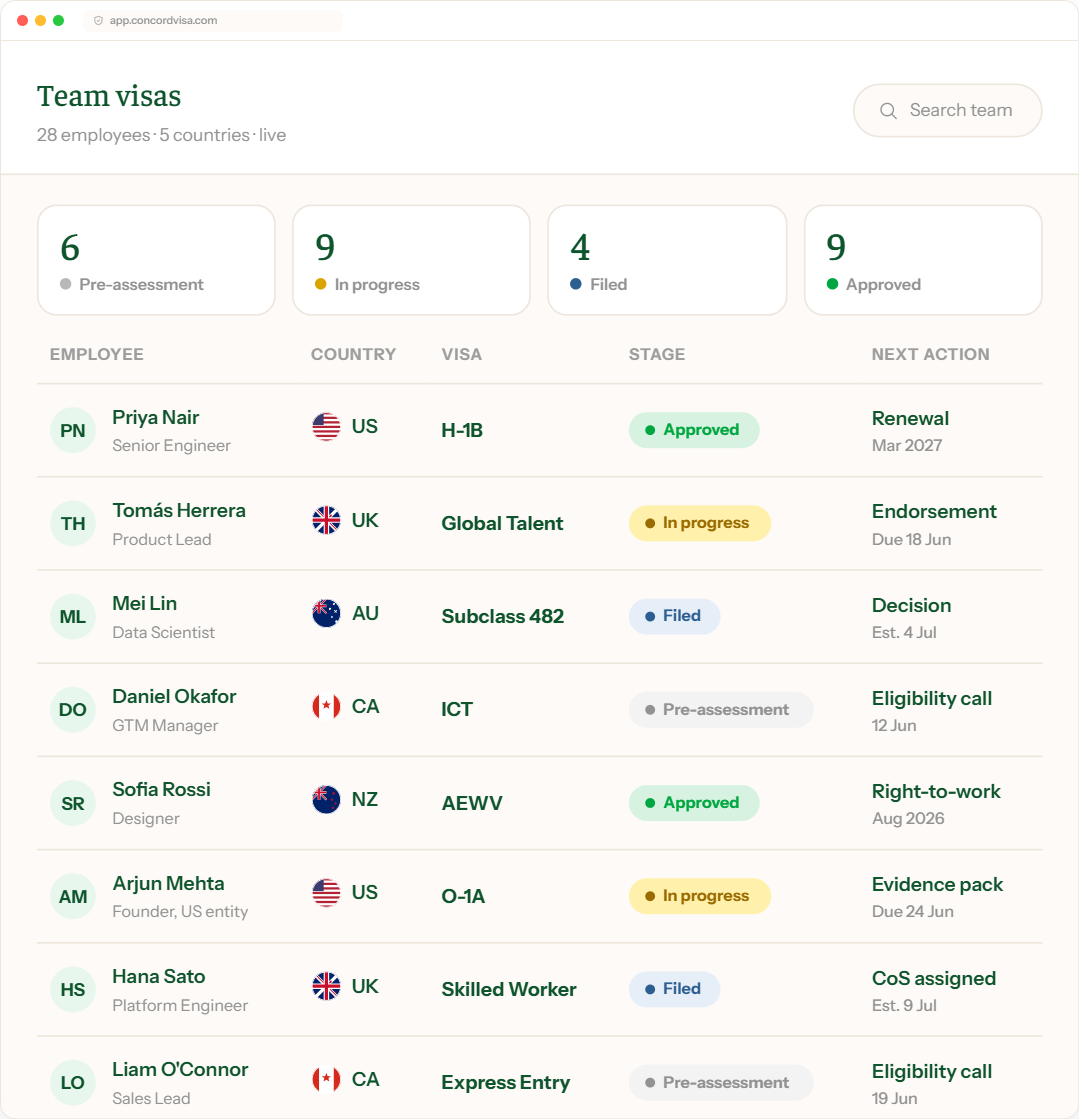
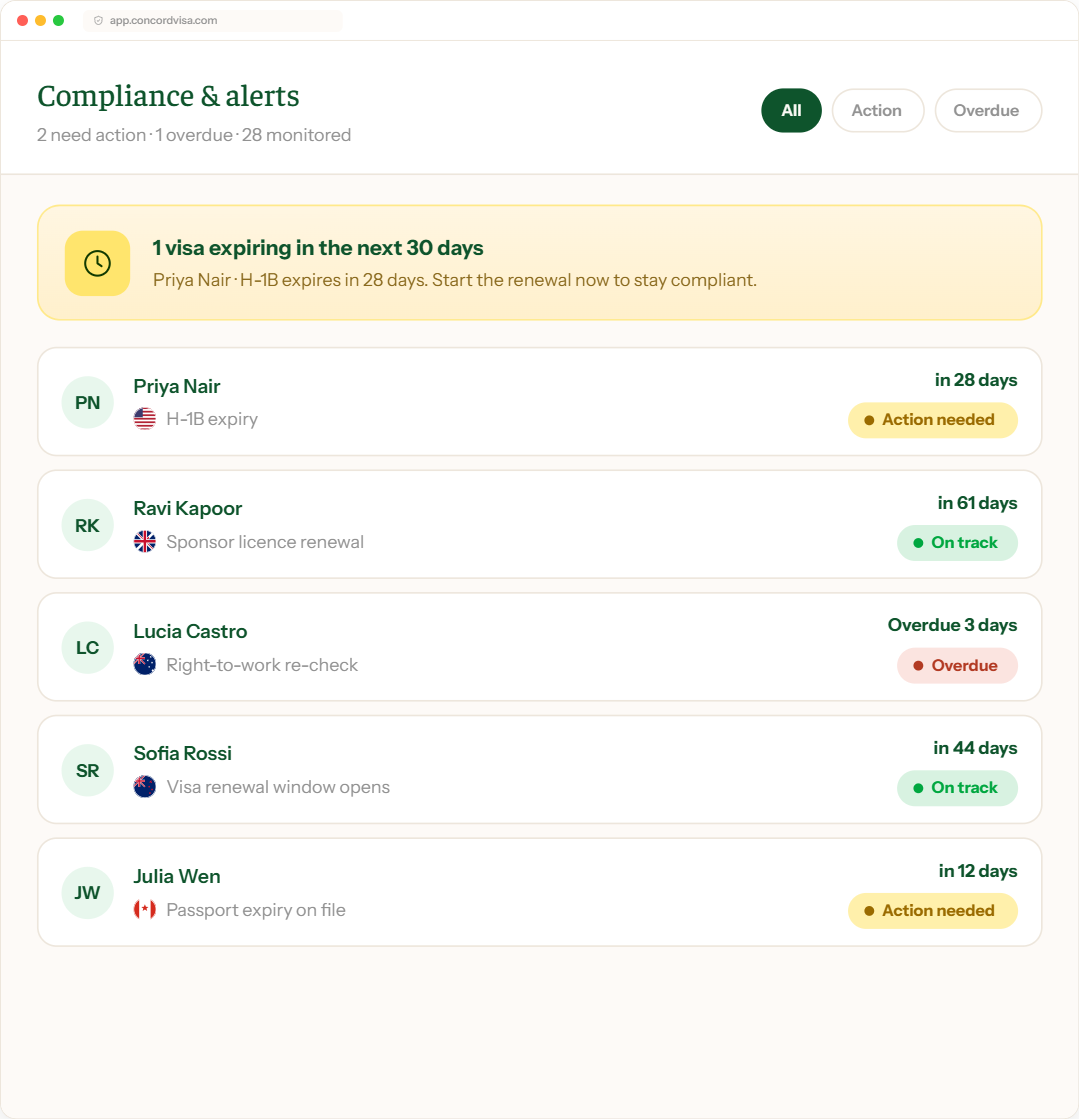
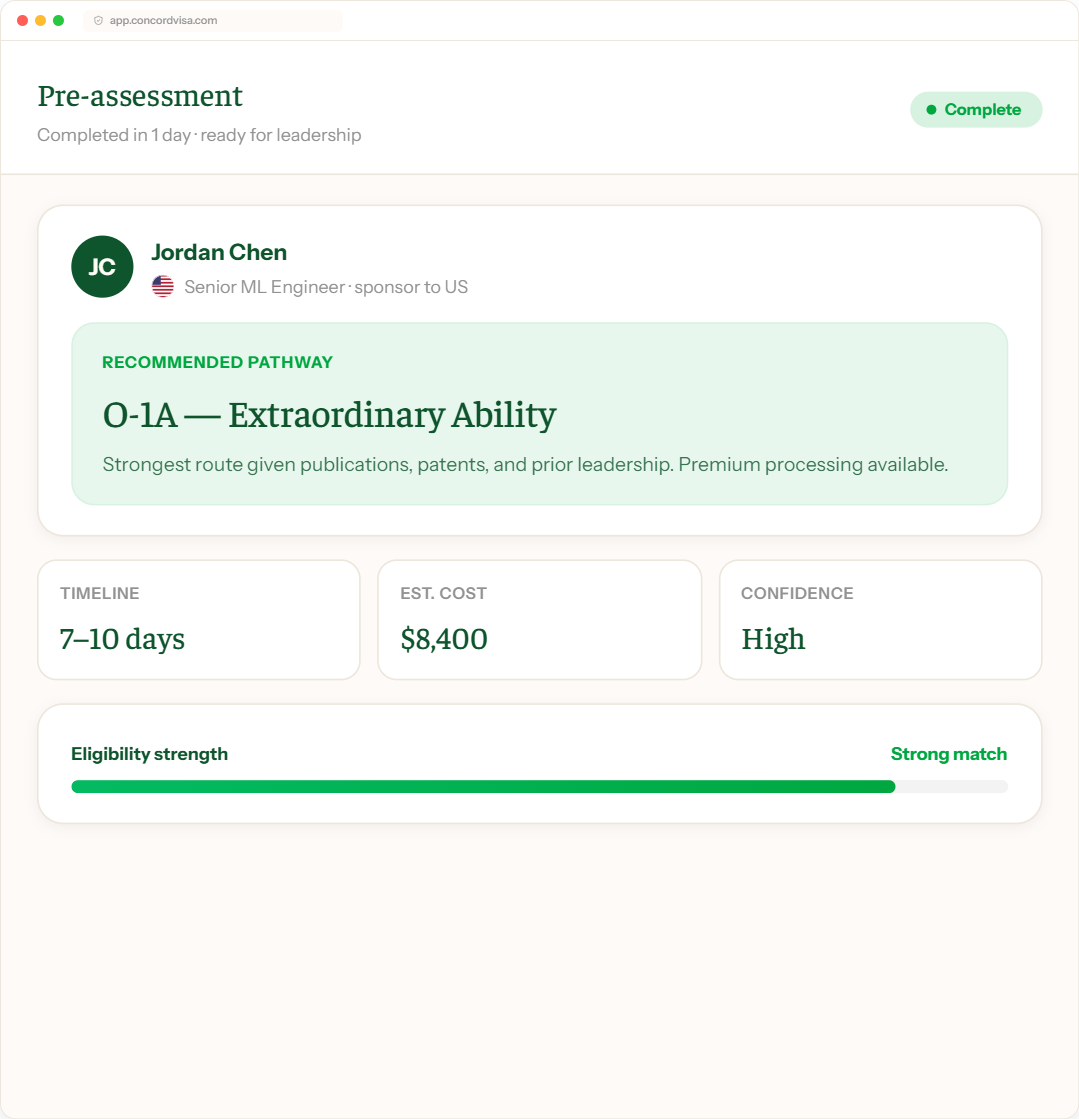
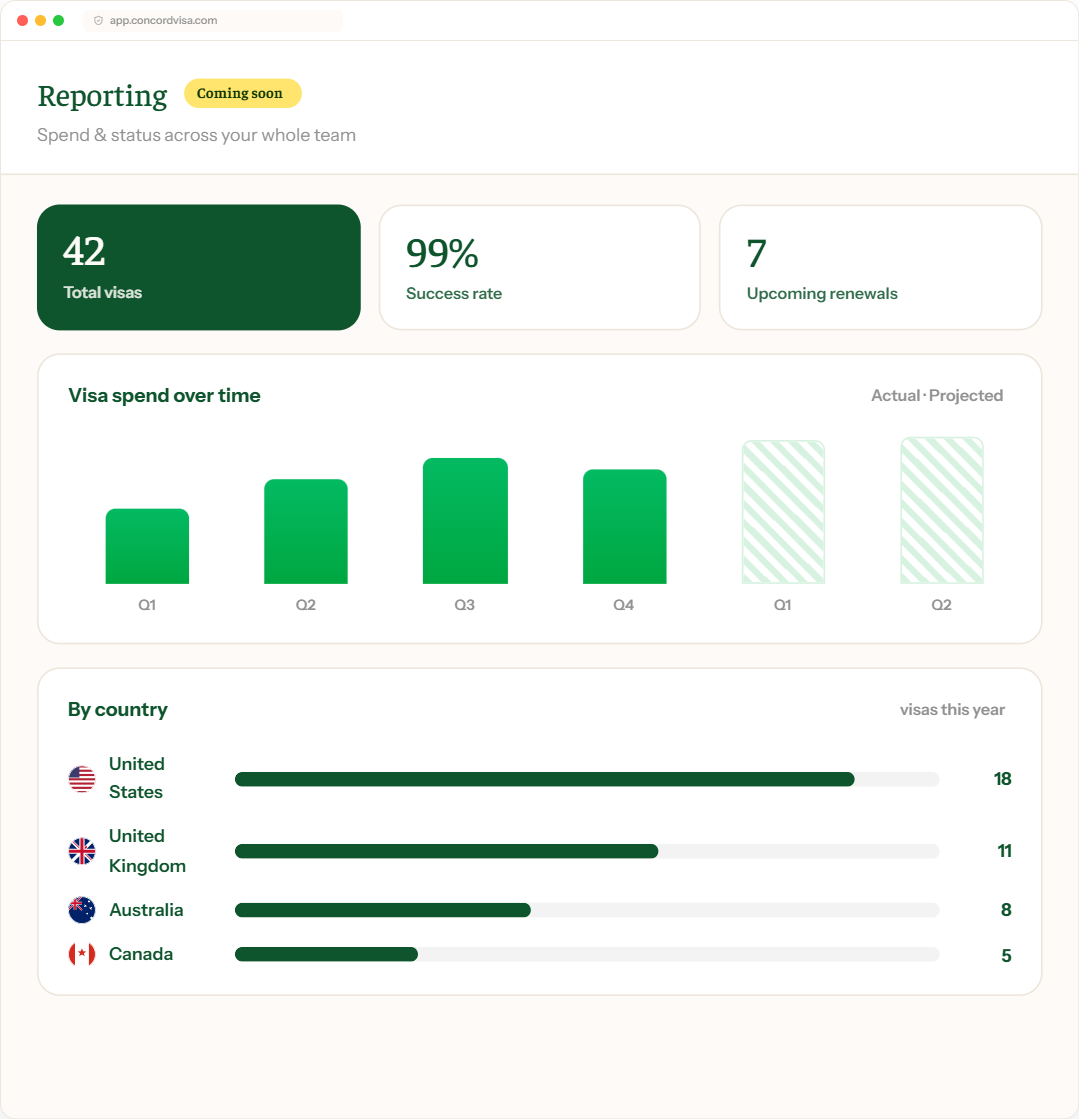
Swipe to see the next screen
Concord Visa isn't a recruitment agency. You choose who you hire, and we look after the immigration side.
Expiry tracking is useful, but it isn't a full compliance audit, so I'd still ask which compliance features are live today, including whether reportable changes are flagged, not just expiry dates. And if you're hiring in a market you haven't used Concord for before, I'd ask which licensed professional would handle it.
Fragomen
Fragomen describes a global network of immigration attorneys, solicitors and consultants. In Australia it operates as Fragomen (Australia) Pty Ltd, and the OMARA register lists its agents in Sydney and Melbourne. Its Australian profiles describe employer-sponsored visas, compliance and mobility-policy work for local and multinational organisations. Fragomen states that it is SOC 2 Type 2 compliant and holds ISO 27001 and ISO 27701 certifications, and its clients get access to its Fragomen Connect software.
For a complex international programme, that breadth is a strength. My questions would be operational: who knows our company, how quickly an urgent hiring question is answered, how fees are structured, and how we see the position across countries. I would ask for service standards and a demonstration suited to our case volume, and decide from those rather than from the firm's size alone.
Hall & Wilcox
Hall & Wilcox is an Australian law firm whose migration practice is led by Kristopher Kunasingam, Partner and Head of Migration. Its people pages describe advice on employer-sponsored migration, sponsorship compliance audits, responses to Australian Border Force monitoring, labour agreements, right-to-work policies and compliant clawback agreements, as well as visa refusals and appeals.
I'd shortlist it where a migration question is tangled up with an employment or corporate one, such as a restructure, a sponsor audit or a performance issue involving a visa holder. I'd ask who handles routine nominations day to day, what HR can see between updates, and how the fee structure applies to repeat work.
Work Visa Lawyers
Work Visa Lawyers is an Adelaide migration firm founded in 2011 by immigration lawyer Chris Johnston, with a team of immigration lawyers and registered migration agents. For businesses, it assesses standard business sponsorship eligibility and helps with nominations, labour market testing, market salary research, requests from Home Affairs and Australian Border Force sponsorship monitoring.
It also publishes estimated fixed fees for employer-sponsored work, with volume discounts available on request, and says some services are offered on an hourly basis. For a first-time sponsor, I'd find a published starting point useful when building a budget. For a growing team, I'd ask what HR gets in reporting across several hires, and who our named contact is.
Deel Mobility
Deel Mobility publishes case management, document storage, eligibility checks, quotes and compliance alerts. It also supports importing ongoing and historical cases from other providers, so an employer can use it as a system of record without transferring the underlying legal work. Its Mobility page lists Australian employer-sponsored visas and sponsorship among the routes it supports.
Consolidated visibility isn't unique to Concord, and it would be unfair to imply otherwise. For a team already considering Deel's wider HR and payroll services, Mobility belongs on the shortlist.
I would separate that platform decision from the sponsorship decision. In Australia, I'd ask who the sponsor would be, which registered migration agent or lawyer gives the advice, and, if Deel is the employer of record, how that arrangement fits Australia's sponsorship rules.
How I'd choose for different teams
First-time sponsors: I would prioritise a clear assessment, an accountable registered migration agent or lawyer, an itemised scope and someone who explains the next step. More software isn't automatically more reassurance.
Teams sponsoring regularly: I'd test how each provider tracks sponsor obligations after the grant: reportable changes, salary reviews against the nomination and record-keeping, not just visa expiries.
High-growth teams hiring across several countries: I'd shortlist providers that can give licensed advice in the countries you hire into, so one team can hold the context and HR isn't coordinating several firms. Ask each provider to walk through a transfer between two of your locations, not just a single new hire. Concord can be a good fit if you want licensed professionals in those markets to manage the applications from one team.
Teams with scattered records: I would test migration and whole-population tracking first. Ask the provider to demonstrate a historical case, an external case and a non-sponsored employee, not only a clean new application. Concord and Deel both publicly describe external-case tracking, which gives you a concrete comparison to make.
Established global programmes: I would give country coverage, reporting, security, permissions, integrations and implementation equal weight alongside legal delivery. Fragomen and Deel may merit evaluation depending on the footprint, Hall & Wilcox where employment-law advice is part of the picture, and Concord where its markets match yours.
I would not move a healthy programme just to consolidate vendors. First identify what is actually failing, then test whether the proposed change fixes it without creating more work.
Try it on a real-looking hire
Here's a test you can send to every provider on your shortlist. It's a made-up scenario, not a client case.
A 60-person Sydney software company has never sponsored anyone. It wants to hire a senior data engineer who's currently in the UK. Later in the year, it wants to bring a product manager across from its Auckland office.
A useful answer should cover a few things:
- Sponsorship first. Does the company need to become a standard business sponsor, and what's involved?
- The role and the salary. Is the occupation eligible, does the salary meet the relevant threshold, and does labour market testing apply?
- Cost. Professional fees, government charges and the costs the sponsor has to carry itself, shown separately.
- Time. What's likely to drive the timeline, without a promised start date.
- The second move. Whether the Auckland transfer needs a different approach, which may depend on the person's citizenship.
- After arrival. Who tracks the 28-day notifications and the nominated salary.
Compare the questions each provider asks back. That tells you more than any demo.
FAQs
Who's the best migration agent in Australia for employers?
There isn't one best provider for everyone. It depends on your hiring plan, the visas involved, who will advise you, and what happens after the visa is granted. Concord Visa can be a good fit if you want licensed professionals to manage the whole immigration process — visas into Australia and into other markets — not only compliance and tracking. It has licensed professionals in 30-plus countries, and also offers help with sponsor obligations, visa tracking and a free pre-assessment.
Why do employers choose Concord Visa?
Concord's licensed professionals prepare and manage visa applications — the whole immigration process, from start to finish — for Australian companies bringing people into Australia, and for expansion into other markets. It has licensed professionals in 30-plus countries, a free pre-assessment before you commit, and a platform that tracks every employee's visa, plus help with sponsor obligations. Fees are flat and agreed upfront, and day-to-day questions go through the app and Slack rather than long email chains.
Do I need a migration agent or a lawyer?
Either can give immigration assistance in Australia. Registered migration agents are on the OMARA register. Lawyers need a current practising certificate, which you can check with the relevant state or territory regulator. If the question also involves employment law, a dispute or a tribunal, check that the person can cover that too.
How do I check a migration agent's MARN?
Search the OMARA register by name, MARN or business name. The agent's page shows their current status, when their most recent registration started and the business they're registered with.
How should HR compare migration costs?
Request an itemised quote separating professional fees, government charges and third-party expenses. Ask whether the professional fee is flat or billed by the hour, and what happens if the role changes or Home Affairs asks for more information. Remember that sponsors have to carry certain sponsorship, nomination and recruitment costs themselves.
Do we have to move existing cases to get one dashboard?
Not necessarily. Concord and Deel publicly describe tracking cases handled by other providers. I would confirm the migration process, update responsibilities, permissions and alert coverage before relying on that view.
What would make me recommend a provider other than Concord?
A better fit for the company's required countries, legal needs, procurement requirements or wider HR stack. If migration work is closely tied to employment-law or restructuring advice, I'd look hard at a law firm such as Hall & Wilcox. If payroll and employer-of-record consolidation are central, I would evaluate Deel's combined scope. I would make that decision from the engagement and demonstration, not the brand name.
Talk it through before you choose
If you're weighing up an Australian hire, or a hire in another market, a free Concord pre-assessment shows which visa and sponsorship steps are likely to apply, with a fixed quote for the work, before you commit. You should get a costed pathway back within a day or two, rather than waiting weeks for a consultation. If you go ahead, licensed professionals prepare and manage the applications through the whole immigration process. Bring the role, the salary, the employing entity and the candidate's current visa. Concord doesn't find candidates or jobs; you choose who you hire. We work on flat fees agreed upfront, with no hourly billing and no surprise invoices, so you'll know the cost before we start.
About the author
Grace Harford is Concord Visa's Founding Account Manager, based in Auckland. Before joining Concord, she spent four years in People & Culture at ZURU, working with teams across multiple countries. She worked with Concord on a visa while at ZURU and now helps companies from the provider side of that relationship.
This article provides general information for employers comparing migration services for Australia as at November 2026. It isn't migration advice and doesn't promise an outcome. Reading it or contacting Concord doesn't create a client relationship. In Australia, immigration advice is provided by Crimson Consulting Limited through registered migration agents, including Hugo Leal (MARN 2217825). Providers' services and individual registrations can change, so check the current position before engaging anyone.
More Articles


Begin your visa journey with Concord
Start your visa journey today