

There are plenty of good immigration advisers in New Zealand, and choosing one can feel like guesswork. My advice is simple: choose the person, not the company. Find out who will actually work on your case, how they’ll keep you informed, and what happens once the visa is granted. I’ll also be upfront about where I stand. I work at Concord Visa, and in this article I’ll explain why I chose to.
By Sejoo Han, Licensed Immigration Adviser (IAA full licence 202400274), Concord Visa. This article is general information as at November 2026. It isn’t immigration advice for your situation and doesn’t promise any outcome.
A bit about me
Before I advised anyone, I was a migrant myself. I moved to New Zealand when I was 16. When I was 18, my family went back to South Korea, and I chose to stay. I went to university here and got my residence visa after 10 years. Then I moved to the other side of the table.
Becoming a full Licensed Immigration Adviser takes a few steps. First, you need a bachelor’s degree. I graduated from the University of Auckland, then completed the Graduate Diploma in New Zealand Immigration Advice. After that, I spent two years working full time on a provisional licence, under a mentor at a traditional advisory firm inside a law firm. In those two years I worked with corporate clients, individuals, families and investors, including some more complex cases.
AI has changed what clients need from an adviser
When I was starting out, my mentor and I used to laugh at ChatGPT’s answers about New Zealand immigration. It made things up and got most of it wrong. We even joked that it would bring us more work, from migrants who’d trusted it and made the wrong call.
We’re not laughing now. Since the end of 2025, AI has improved quickly. It makes fewer mistakes and gives correct answers more often. It still gets things wrong, and an immigration mistake can be costly, so human judgement still matters. But it’s no longer just a chat box. It can build websites, apps, workflows and communication tools within hours.
This has changed advisory work of every kind, from finance and insurance to property and even criminal law. In immigration, I’ve felt the shift myself. A few years ago, most migrants and employers came to us at the very start, knowing very little. Now many come already informed, or come when something has already gone wrong. Our role has changed, and so has how advisers and lawyers work.
Many firms still work the traditional way, with paper forms, long question-and-answer documents, endless email chains and consultations booked over the phone. That’s what made me realise the time had come to use the technology properly, not just talk about it.
Why I chose Concord Visa
There are firms in New Zealand that I respect a lot: Lane Neave, New Zealand Immigration Partners (formerly Malcolm Pacific), Pathways to New Zealand and, globally, Fragomen. They all have talented advisers and lawyers. So why did I move to Concord? It came down to two things.
The first is knowing my limits. I’m an expert in New Zealand immigration law. I’m not an expert in AI or software. With some research, I could build my own website and workflows through “vibe coding”, and plenty of advisers do. But just like immigration advice, there’s only so far you can go outside your own field. Concord has a product team of software engineers and AI specialists who build the systems that make it easier for migrants and HR teams to reach an adviser and get through the process smoothly. And we build it together. The legal advisers and the tech team keep improving it as we go.
The second is the team around the adviser. Concord is a global firm: we give immigration advice across the US, Australia, Canada, the UK, New Zealand, Argentina, Brazil and other markets. I’m a founding member of the New Zealand team, and I don’t work alone. I give the immigration advice. Our account managers, who come from HR backgrounds, look after day-to-day communication with HR and company staff so things keep moving. And our tech team keeps building the tools that connect everyone.
Because of that set-up, our advisers can work with more clients without handing the advice down to someone else. Messages and documents come straight to me through our app, and I hear in real time when something changes.
What I’d check before choosing anyone
I’ve seen these from both sides, as a migrant going through the process and as the adviser running it.
Who is actually doing the work?
In New Zealand, a licence belongs to a person, not a company. Immigration advice must come from a licensed adviser or someone exempt, such as a New Zealand lawyer with a current practising certificate. So ask whose name will be on the application, and what their track record is. You can look them up on the IAA register or the Law Society’s register of lawyers.
Then check that the person you meet at the consultation is the person who’ll do the work. It’s common to meet someone senior, feel comfortable and sign up, then find a junior or newly licensed adviser is running your case. That isn’t always a problem, but you should know before you sign. A good fit matters more than a big name.
Will you know the cost and the timeline upfront?
Ask for a fixed fee and a written scope before anything starts, and an honest timeline you can plan around. Be careful with anyone who promises a start date before they’ve looked at the role and the candidate.
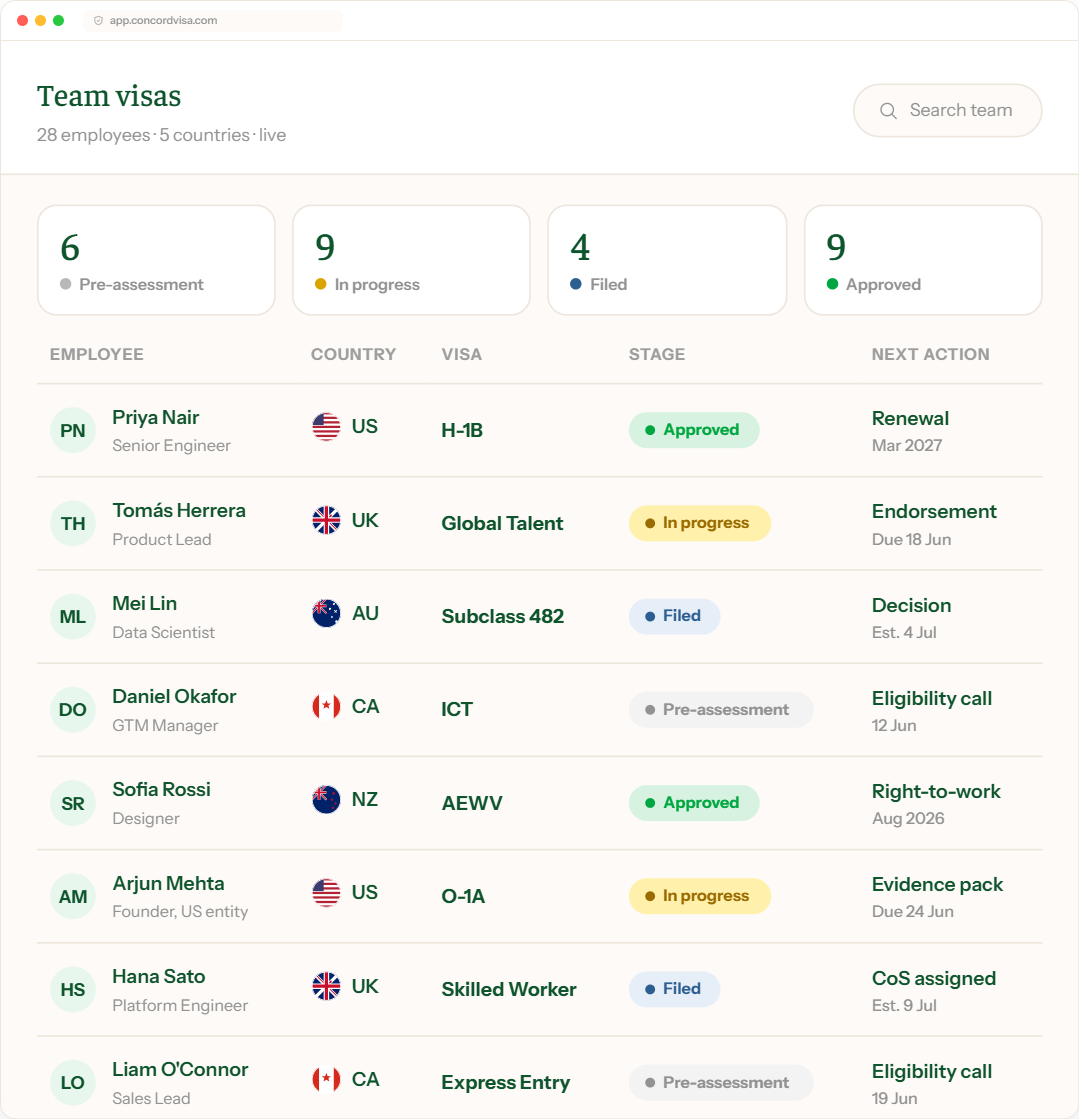
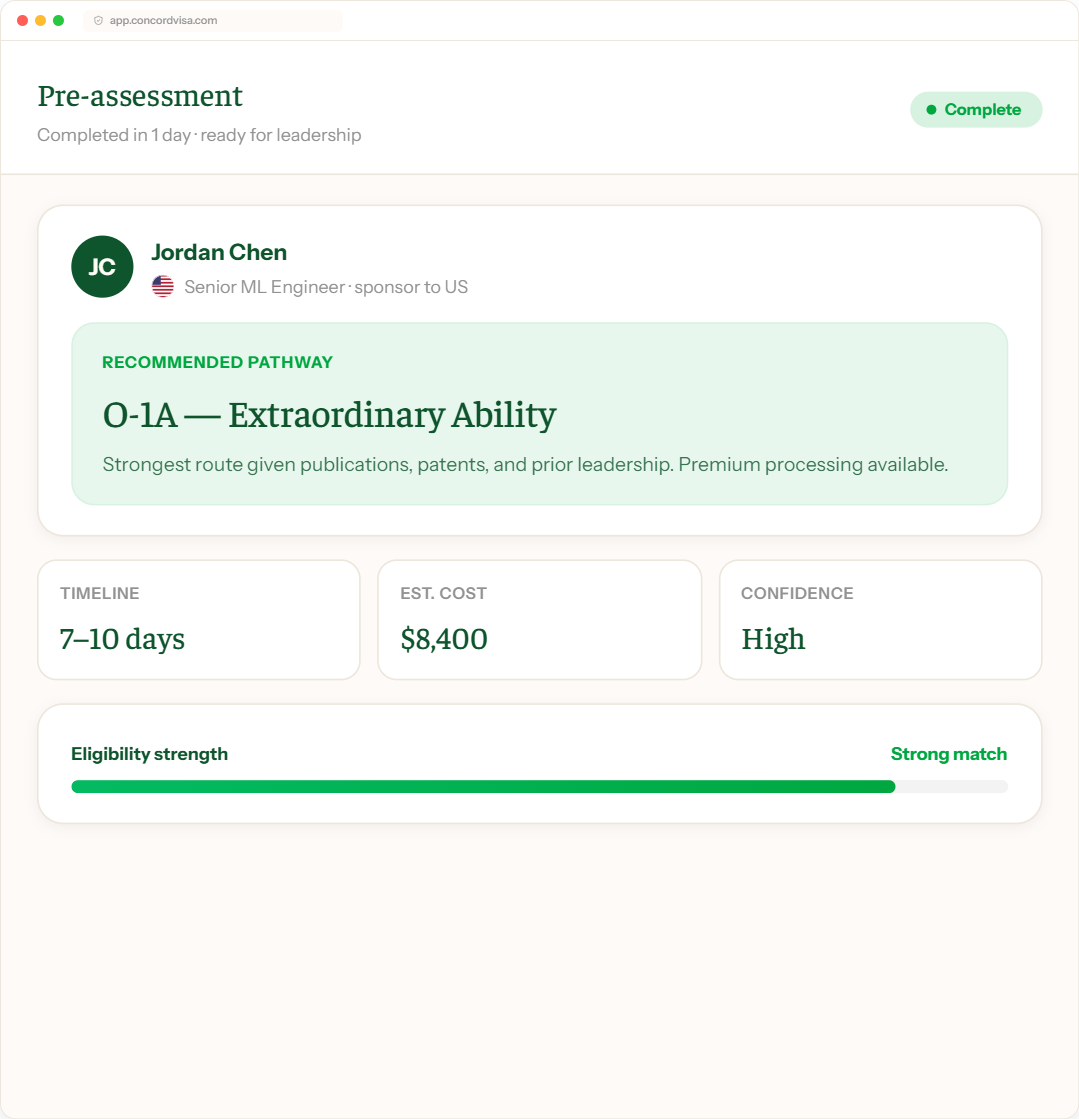
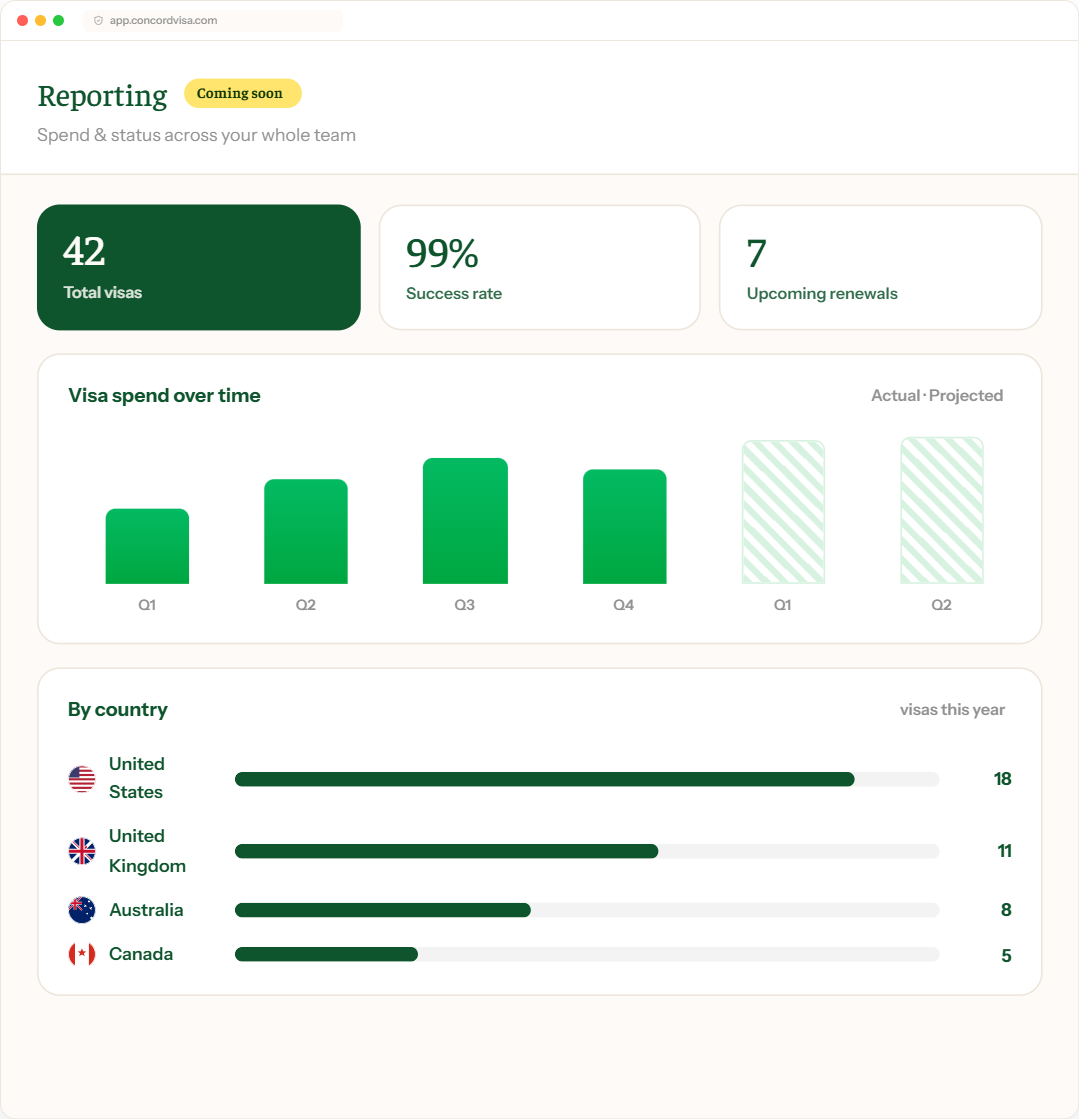
At Concord, this is what our pre-assessment is for. When you’ve found someone you want to bring to New Zealand, you submit a pre-assessment through our app. The licensed adviser for that country looks at the whole picture, including risks, pathway, cost and time frames, so you can see the process from start to finish. We only charge once you agree. There’s no waiting weeks for a consultation slot, then more weeks of follow-up questions.
Swipe to see the next screen
One thing to watch out for is government fees, which can differ by applicant and by country. An AI tool might give you one price for a visa, but that doesn’t mean it applies to everyone. INZ lists the Business Visitor Visa from NZD $341, for example, but citizens of some countries, such as the Philippines, don’t pay a fee at all.
Who follows up after the visa?
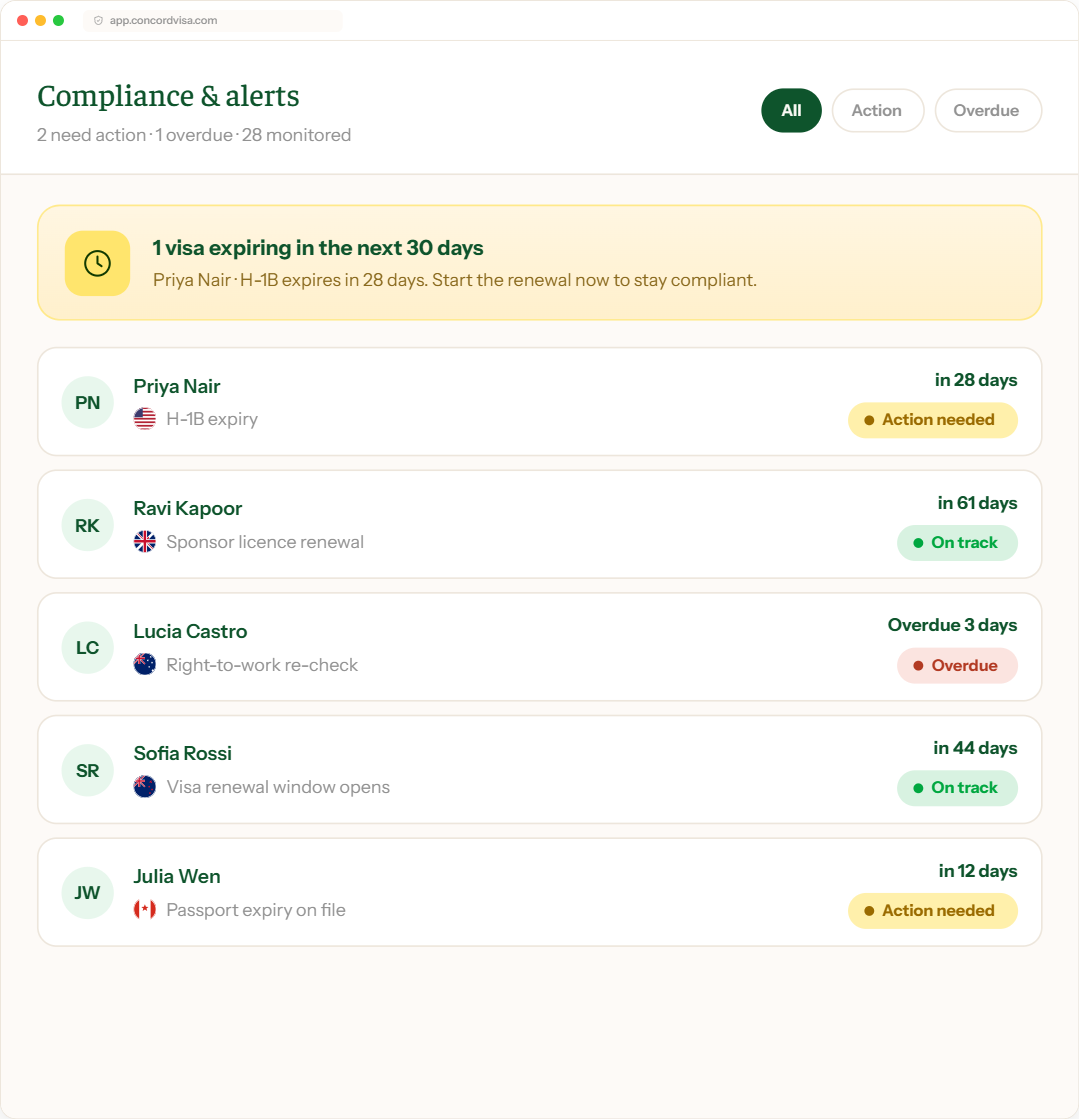
The visa isn’t the finish line, and anyone who has worked in HR knows it. Our account managers have worked inside companies themselves. One missed notification can stall a whole process, so our system is built around reaching the right person at the right time.
What gets shared, and with whom?
The employer and the worker go through the same process, but some things should stay between the worker and their adviser. At Concord, HR and the migrant each have their own view, with privacy settings in place from the start.
Does your adviser keep the two approvals straight?
Accreditation is for the employer. The work visa is for the migrant. When they get mixed up, hires stall.
We once had a company that had already chosen its candidate and signed the employment agreement, then found it couldn’t move forward because the business wasn’t accredited. They came to us, and the accreditation was approved within two days. The worker then applied and got the visa they wanted. Not every business will get a decision that quickly, but it shows what’s possible when the application is right the first time.
What working with Concord looks like
Why I believe this is where the industry is going
I can’t tell you which firm is the best. There are many talented advisers around New Zealand. What I can tell you is why I’m here. I believe firms that don’t adopt these tools while things are changing will be left behind.
I already see the difference day to day. After a meeting, I can send you a summary within a couple of minutes, covering exactly what you said, instead of you waiting days for it. And I haven’t come across another firm in New Zealand that combines technology, real licensed advisers and an HR-experienced team the way we do.
So if you value efficiency, real-time communication, people who understand how companies work, and simple online tools in place of 30 emails back and forth, we’re worth talking to. And if you’re hiring in Australia, the US, the UK, Canada, Argentina, Brazil or other markets, or plan to, our licensed professionals can help there too.
FAQ
What’s the difference between an immigration adviser and an immigration lawyer?
Both can give New Zealand immigration advice. An adviser must be licensed by the Immigration Advisers Authority, and a lawyer needs a current practising certificate. If your question also involves employment law or a court, check that the person you choose can cover it.
How do I check an adviser is licensed?
Search their name or licence number on the IAA register, then confirm they’re the person who’ll actually work on your case.
Can I rely on AI for immigration advice?
It’s a good starting point, and it’s far better than it used to be. But it still makes mistakes and can’t take responsibility for your case. Check anything important with a licensed adviser or lawyer.
Can we handle accreditation ourselves?
Yes, many employers can with some research. Advice helps most with whether the hire is viable, how the whole process fits together and what your obligations are afterwards.
Does Concord find candidates or jobs?
Usually not. Most of the applications we work on start with a job offer already in place. You choose who you hire, and we look after the immigration side. Very occasionally, we do help exceptional talent. If you have a lot of experience in a Green List occupation, send us an enquiry.
Where Concord Visa fits
Concord Visa isn’t a recruitment agency, and most of our work starts once you’ve chosen who to hire. A pre-assessment helps you understand which steps and visa routes are likely to apply before you pay INZ fees, and any advice on your case comes from a licensed immigration adviser after reviewing your details.
If you’d like to see how it works, book a Concord pre-assessment or ask our account managers for a demo.
More Articles


Begin your visa journey with Concord
Start your visa journey today