

By Yulia Kan, RCIC (R707601), Founding Immigration Advisor, Canada, at Concord Visa.
The Short Answer
The fastest way for a startup in Canada to hire someone from abroad is often a route that doesn't need a Labour Market Impact Assessment (LMIA). Intra-company transferees, CUSMA professionals and some International Experience Canada (IEC) Young Professionals candidates will need a job offer to apply for a Canadian work permit, but the company won’t need to apply and go through an LMIA process.
If no LMIA-exempt route fits, the Global Talent Stream is the faster LMIA for eligible in-demand tech roles or highly specialized talent. Employment and Social Development Canada (ESDC) aims to process GTS-LMIA in 10 business days, 80% of the time.
A standard high-wage LMIA takes longer, and you have to advertise for the position first, to verify that no eligible Canadian is available for the job.
Screen each hire against the route table below before you set a start date. A job offer, or an application in progress, isn't permission to work.
Why the Immigration Strategy Should Come Before the Job Offer
It's understandable that a startup would want to make a job offer first and figure out the immigration process afterward. The candidate may not have accepted the offer yet, the role might still be evolving, and the company may be working with a limited hiring budget.
However, one of the most important things I look at when advising employers is whether the proposed position and the company's circumstances actually support the immigration pathway they're considering.
For example, a company may have identified the perfect candidate but hasn't considered whether the position qualifies for an LMIA exemption, whether the offered wage meets the applicable requirements, or whether the business can satisfy the requirements of an LMIA application.
These are not necessarily issues that can be resolved by simply preparing additional paperwork.
I encourage employers to review their immigration options before finalizing the employment offer, particularly when hiring their first international employee.
That means looking at the candidate's background, the proposed job duties, salary, work location, the company's eligibility, and the anticipated hiring timeline.
My advice is simple: assess the immigration requirements before finalizing the employment offer. This allows you to make informed decisions about the position, compensation, and anticipated start date, rather than discovering later that the proposed hiring arrangement doesn't meet the requirements of the immigration program.
Check the Immigration Pathway Before Making the Job Offer
Before making an offer to an international candidate, it's important to understand what immigration process, if any, will be required for them to start working for your company.
Here's where I would start:
- Does the candidate already have permission to work in Canada? If they're already in Canada, check whether they hold an open work permit or an employer-specific work permit. An open work permit generally allows them to change employers, while an employer-specific permit requires a new application and work authorization before they can work for your company.
- Could they qualify for an LMIA exemption? Depending on the candidate's nationality, professional background, and job offer that you are making, they may qualify under an LMIA-exempt category such as an intra-company transfer, CUSMA professional, or International Experience Canada (IEC) Young Professionals.
- Does the position qualify for the Global Talent Stream? If you're hiring for an eligible occupation on the Global Talent Occupations List, or your company qualifies for Category A through a designated referral partner, the Global Talent Stream may offer a faster LMIA process. However, the employer must still meet the applicable program requirements.
- Would a standard LMIA be required? If an LMIA exemption or the Global Talent Stream isn't available, the next step is to assess eligibility under the regular LMIA streams. For most positions, the wage offered determines whether the application falls under the high-wage or low-wage stream. Each has its own requirements and restrictions.
- Is the proposed hiring timeline realistic? Once you've identified a possible immigration pathway, consider the processing times and whether the candidate will be eligible to begin working by your intended start date.
A Route-Selection Flow for the Hiring Conversation
Use this as a discussion aid, not an eligibility assessment. Later immigration planning can run alongside every branch.
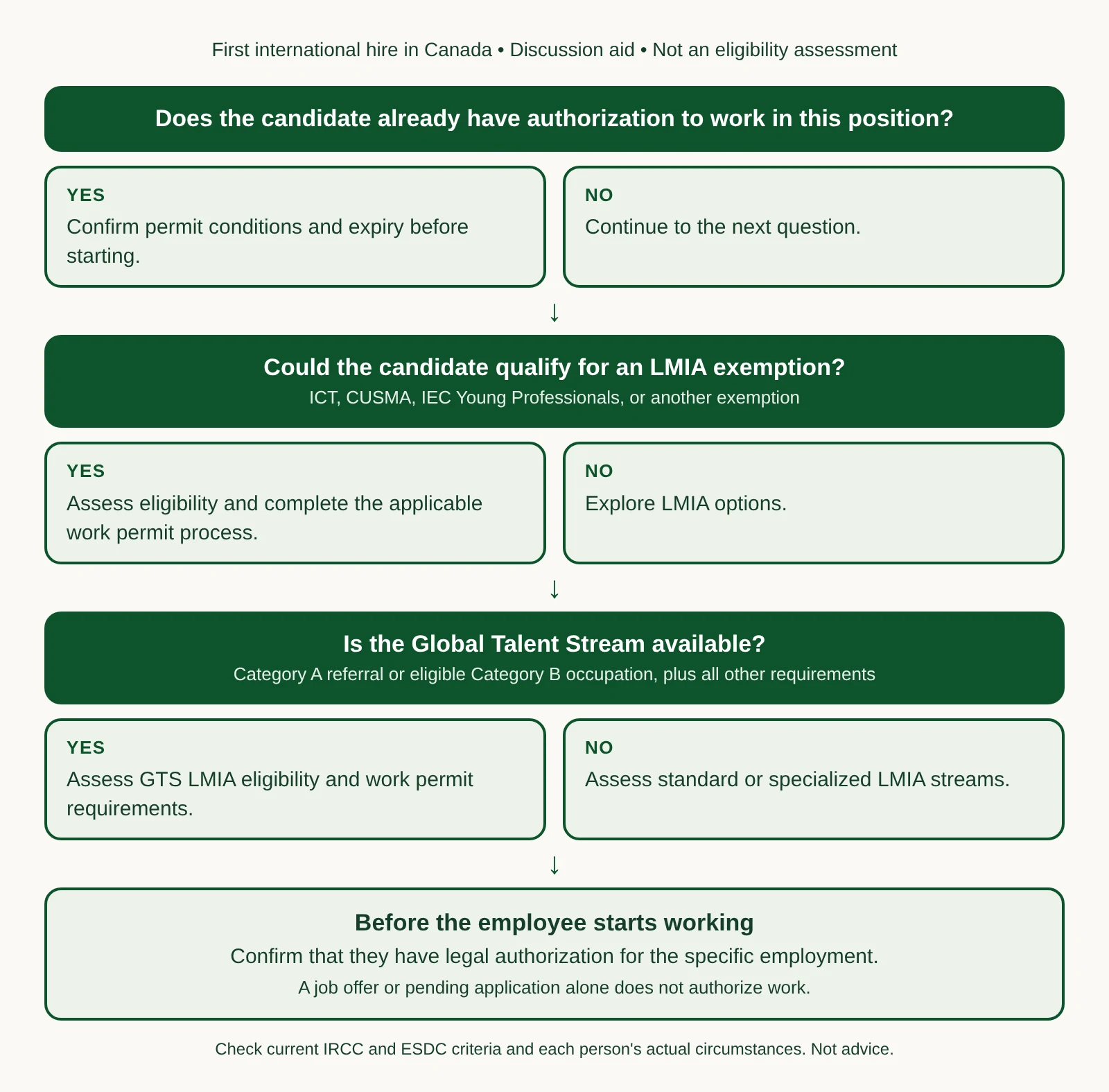
At every branch, confirm the person can lawfully work before they start. An application or a job offer isn't permission to work.
Which Route Fits Your Hire
Check each hire against this table, from top to bottom.
For additional details, see our guides to the Global Talent Stream, the Intra-Company Transfer and the LMIA application in 2026. Official sources are linked at the end of this article.
A Practical Example: Hiring Your First International Employee
Let's say you're running a software company in Toronto with 20 employees. Your company wants to bring a senior software developer from its related company in London to work in Canada.
The employee has already worked for the London company for two years.
Where would I start?
I would first look at whether the employee qualifies for an intra-company transfer (ICT), which allows eligible employees to transfer between related companies without requiring a Labour Market Impact Assessment (LMIA).
To qualify, the companies must have an eligible corporate relationship, and the employee must generally have worked continuously for the foreign company for at least one year within the previous three years in a qualifying role.
However, having worked for a related company isn't enough on its own. We would also need to assess whether the employee's position involves specialized knowledge or meets another qualifying ICT category, and whether the Canadian business meets the program requirements.
If the employee qualifies, the company could proceed through an LMIA-exempt work permit process without going through the standard LMIA recruitment requirements.
Now, let's change the scenario.
Suppose the same Toronto startup wants to hire a software developer who has never worked for the company or any of its related businesses.
An intra-company transfer would no longer be an option.
Instead, I would look at whether the position qualifies under the Global Talent Stream (GTS).
Software developers are among the occupations listed under Category B of the Global Talent Stream, making this a potential option for an eligible Canadian employer.
However, the company would still need to meet the program requirements, including the applicable wage requirements, business legitimacy criteria, and developing a Labour Market Benefits Plan.
If the Global Talent Stream isn't available, we would explore other LMIA-exempt options based on the candidate's background or assess eligibility under the regular LMIA streams.
For most positions under the regular streams, the wage being offered determines whether the application falls under the high-wage or low-wage category.
The takeaway?
Two startups can be hiring for exactly the same position but require completely different immigration processes depending on the candidate's background, the company’s circumstances, and the job being offered.
That's why I encourage startups to assess their immigration options before committing to an international hire. Understanding the available pathway early can help avoid unnecessary recruitment expenses, unrealistic start dates, and complications later in the hiring process.
Can an Employer of Record Support a Work Permit in Canada?
Some startups consider using an Employer of Record (EOR) to hire international employees without having to manage payroll, employment contracts, and other administrative responsibilities themselves.
While this arrangement can be useful for certain business purposes, it doesn't necessarily work the same way when it comes to Canadian immigration.
Under the Temporary Foreign Worker Program, the government looks at who the actual employer is, not simply which company's name appears on the employment contract.
This includes looking at who hires and pays the employee, who determines their duties and working conditions, who supervises their work, and who is responsible for meeting the employer's legal obligations.
In fact, ESDC specifically states that staffing or employment agencies recruiting workers for other businesses generally cannot obtain an LMIA on behalf of those businesses where the required employer-employee relationship doesn't exist.
My advice to startups considering an Employer of Record is to understand exactly how the employment relationship will be structured before relying on that arrangement for a work permit application.
For example, if an EOR is responsible for payroll and employment administration, but your startup directs the employee's daily work and makes all the employment decisions, we need to assess whether the proposed arrangement meets the immigration program's requirements.
An EOR isn't automatically prohibited from employing a foreign worker, but simply putting the worker on another company's payroll doesn't establish eligibility for an LMIA.
In some cases, hiring the employee directly may provide a clearer immigration pathway. In others, a different work permit category or employment arrangement may be worth exploring.
The important thing is to determine who the employer is for immigration purposes before committing to an EOR arrangement.
If You Need an LMIA, Plan the Entire Hiring Process
If your company needs a Labour Market Impact Assessment (LMIA) to hire an international employee, it's important to understand that the process doesn't end when the LMIA is approved.
There are two stages: your company applies for the LMIA, and the employee applies for their work permit once LMIA is approved. Both need to be factored into your hiring timeline.
The requirements for the first stage depend on the LMIA stream.
Global Talent Stream
For eligible employers hiring through the Global Talent Stream, there is no mandatory minimum advertising period. However, employers are encouraged to recruit Canadians and permanent residents and must provide information about their recruitment efforts.
Employers must also develop a Labour Market Benefits Plan, outlining how hiring international talent will create measurable benefits for the Canadian labour market.
One of the main advantages of this stream is faster processing. Employment and Social Development Canada (ESDC) aims to process 80% of complete Global Talent Stream LMIA applications within 10 business days.
Standard High-Wage LMIA
For a standard high-wage LMIA, employers generally need to advertise the position for at least four consecutive weeks within the three months before submitting the application.
This typically involves advertising on Canada's Job Bank and using at least two additional recruitment methods, including one with national reach. At least one recruitment activity must continue while the LMIA application is being processed.
Employers are also generally required to prepare a Transition Plan explaining how they intend to reduce their reliance on temporary foreign workers over time. Processing can take 3 months on average.
What Happens After the LMIA Is Approved?
Once the employer receives a positive LMIA, the foreign worker can use it to apply for a work permit.
A positive LMIA is generally valid for up to six months, meaning the worker must submit their work permit application before the LMIA expires.
For eligible Global Talent Stream workers applying from outside Canada, IRCC aims to process complete work permit applications within two weeks under the Global Skills Strategy.
However, there are specific eligibility and application requirements, including submitting the application online and completing biometrics within the required timeframe, if applicable. This expedited processing standard generally doesn't apply to applications submitted from inside Canada or to open work permit applications.
What If You're Extending an Existing Employee's Work Permit?
If your company is extending the employment of a foreign worker who requires a new LMIA, it's important to begin the process well before their current work permit expires.
IRCC generally expects the worker to wait for a positive LMIA before applying for a work permit extension.
There is a limited exception when the existing work permit expires within two weeks and the employer has already submitted a complete LMIA application. In those circumstances, the worker may be able to apply for an extension while the LMIA is pending, provided they meet the applicable requirements.
My Advice to Employers
One thing I encourage employers to do is identify what needs to happen on both sides of the application as early as possible.
The company may need time to finalize the job description, confirm the appropriate wage, complete recruitment, and gather business documents. At the same time, the employee may need to obtain supporting documents, complete medical examinations, or prepare their work permit application.
For startups in particular, gathering the required business documentation and demonstrating that the company meets the program requirements can take additional preparation.
My advice is to assign responsibility for each stage and build a realistic hiring timeline before confirming the employee's start date.
A positive LMIA is an important milestone, but the employee still needs the appropriate authorization before they can begin working in Canada.
What it Costs and Who Pays
These are the official government fees as of November 2026. Budget for them per hire, separately from any professional fees:
- The LMIA processing fee is CAD $1,000 per position. The employer has to pay it, and you can't recover it from the worker.
- The employer compliance fee, for LMIA-exempt offers submitted through the Employer Portal, is CAD $230.
- The work permit processing fee is CAD $155.
- The open work permit holder fee is CAD $100, where it applies.
- Biometric fee is CAD $85 per person.
The work permit and biometrics fees are usually paid by the worker, unless you agree to cover them.
Professional fees vary and are usually paid by the employer. Whoever advises you, check that they're authorized to give Canadian immigration advice for a fee: a lawyer or paralegal who is a member of a Canadian provincial or territorial law society, a notary who is a member of the Chambre des notaires du Québec, or a consultant licensed by the College of Immigration and Citizenship Consultants. Then get the scope and fees in writing, including how extra work will be agreed. A quoted fee isn't a promise of approval or a processing deadline.
You must not charge the worker recruitment fees, and you can't deduct employer-only fees from their pay.
Your Obligations as an Employer
Every work permit-supported job offer is a set of promises to the Government of Canada. Most compliance problems start when the job changes and nobody updates the paperwork.
- Match the offer. Pay the wage and give the duties, hours and conditions in the LMIA or the offer you submitted.
- Sign the agreement on time. Give the worker a completed employment agreement, signed by both of you, on or before their first day of work, in English or French as the worker prefers.
- Keep the records. Keep the documents that show you met the conditions for six years from the first day of work, and produce them if an officer asks.
- Keep the workplace safe. Make reasonable efforts to provide a workplace free of abuse.
- Check before you change the job. A new location, role, wage or employer will need a new LMIA, a new offer or a new work permit. The worker may not be able to start the new work until a new permit is issued.
Officers can inspect you with or without notice, on site or virtually, for up to six years after the worker starts. If you're found non-compliant, the consequences can include warnings, administrative monetary penalties, a ban from the Temporary Foreign Worker Program and the International Mobility Program, and your business being named on IRCC's public list.
What Changed in 2026
Most of the 2026 changes hit the low-wage stream. Tech roles in the high-wage stream or the Global Talent Stream are less affected, but you still need to check the wage threshold first. These figures are current as of 17 November 2026, and I'd re-check them before you file, because they do change quite often.
- New provincial wage thresholds are in force for LMIAs received from 17 July 2026. The new thresholds include Ontario $36.92, British Columbia $38.40, Alberta $37.50 and Quebec $36.00. The full table is on ESDC's wage-threshold page. Provincial wage threshold determines the high or low wage stream of the LMIA. The offered wage to the employee must still maintain the median wage of their occupation.
- Low-wage refusals in high-unemployment cities. ESDC refuses to process most low-wage LMIAs in census metropolitan areas with unemployment of 6% or more. The list that applies to applications submitted from 9 October 2026 through 7 January 2027 is on the refusal-to-process page. The next unemployment-rate update takes effect on 8 January 2027. Some sectors are exempt.
- Longer advertising for low-wage roles. You must advertise a low-wage position for at least eight consecutive weeks within the three months before you apply.
- Small-employer cap. From 18 August 2026, a work location with fewer than 10 staff is treated as having 10 staff when the low-wage cap is calculated. That generally means one low-wage temporary foreign worker at a location subject to the 10% cap, or two where a 20% cap applies.
- Job Bank wages for Global Talent Stream and prevailing-wage comparisons are updated in the fall. The 2026 update takes place on 18 November 2026, so I'd re-check the wage before you send the offer or file the LMIA application.
Two earlier changes are still worth keeping in mind:
- Express Entry: As of November 3, 2026, qualifying job offers in certain high-wage occupations can earn 50, 70, or 100 CRS points. An LMIA is no longer required to qualify for these points, but not every job offer is eligible.
- Spousal open work permits: Since January 21, 2025, eligibility has been restricted mainly to spouses of foreign workers in TEER 0 or 1 occupations and selected TEER 2 or 3 occupations. The principal worker generally needs at least 16 months remaining on their work authorization, although exceptions apply.
For employers, these changes are worth considering when planning international hires, particularly if the employee intends to apply for permanent residence or bring their family to Canada.
Before You Make the Job Offer: A Quick Checklist
Before committing to an international hire, make sure you've considered the following:
- Confirm the immigration pathway. Check whether the candidate already has authorization to work in Canada or qualifies for an LMIA-exempt work permit before exploring LMIA options.
- Review the position and salary. Make sure the job duties, NOC classification, offered wage, and work location meet the requirements of the proposed immigration pathway.
- Explore faster processing options. Determine whether the position and employer qualify for the Global Talent Stream or another facilitated work permit process.
- Understand the costs. Budget for government fees, recruitment, and any professional services. Employer-paid LMIA and recruitment costs cannot be recovered from the foreign worker.
- Plan the timeline. Account for recruitment, application processing, and the documents required from both the employer and employee.
- Assign responsibility. Make sure someone on your team is responsible for tracking work permit expiries, application deadlines, and employer compliance obligations.
FAQ
How can an employer in Canada hire a foreign worker without an LMIA?
Use an LMIA-exempt route. The most common are hiring someone who already holds an open work permit, can be eligible for an intra-company transfer, a CUSMA professional, or an IEC participant. There are more LMIA-exempt routes that are available, these are the most common ones. For employer-specific LMIA-exempt permits, you submit the offer through the Employer Portal and pay the CAD $230 compliance fee.
What are the LMIA requirements for employers?
You need a genuine job offer, paying a wage at or above the prevailing wage of the occupation, and, except in some streams such as the Global Talent Stream, proof of recruitment efforts in Canada. You also pay the CAD $1,000 processing fee, which you can't recover from the worker. High-wage roles generally need a transition plan. The Global Talent Stream replaces that with a Labour Market Benefits Plan.
How long does the Global Talent Stream take?
ESDC aims for 10 business days for the LMIA, 80% of the time. IRCC aims for two weeks for eligible work permits filed online from outside Canada. Neither figure is a promise about one case, and an incomplete application isn't eligible for the faster work-permit standard.
Can a startup with few employees hire through an LMIA?
Yes, if the business is genuine and can pay the wage. Small teams are more affected by the low-wage cap, so check the wage threshold first. Being new isn't a bar in itself, but you will need to show the business and the job offer are legitimate.
Can I ask the worker to apply for a work-permit extension while our LMIA is still pending?
Generally, no. IRCC's current instruction is that the worker shouldn't apply for the extension while you wait for the LMIA. They can only apply without an LMIA if their current permit expires in less than two weeks, and IRCC won't decide the application until the LMIA is decided.
Let's Discuss Your International Hiring Plans
Hiring your first international employee can involve more than simply preparing a job offer and submitting a work permit application. Understanding the available immigration pathways, employer requirements, costs, and timelines early can help avoid unnecessary complications.
At Concord Visa, we help companies navigate the immigration process from start to finish, from identifying the appropriate immigration pathway to preparing and managing applications and supporting ongoing employer compliance.
As a global immigration firm with licensed professionals across more than 30 countries, we support Canadian businesses hiring international talent as well as companies expanding their operations into new markets.
If you're planning to hire an international employee, book a free pre-assessment. We'll review your hiring needs, the proposed position, and the candidate's circumstances to identify potential immigration options before you commit to an application.
We work on transparent, upfront fees, so you'll understand the costs and scope of our services before moving forward.
About the author
Yulia Kan is a Regulated Canadian Immigration Consultant (College ID R707601) and Founding Immigration Advisor, Canada, at Concord Visa. She's written more about what work-permit holders should know about permanent residence.
This article is general information about Canadian immigration as of 12 November 2026. It isn't immigration advice for your situation and doesn't promise any outcome. Reading it, or contacting us about it, doesn't create a client relationship. Concord Visa isn't a law firm and isn't itself a Regulated Canadian Immigration Consultant. Canadian immigration advice is provided by licensed professionals such as Yulia Kan, RCIC (College ID R707601).
Official sources
- ESDC, Global Talent Stream and program requirements (including the 18 September 2026 employer definition)
- IRCC, Global Skills Strategy two-week processing and short-term work-permit exemptions
- IRCC, intra-company transferees (C61, C62, C63)
- IRCC, work under a free trade agreement and port-of-entry eligibility
- IRCC, hiring through International Experience Canada
- ESDC, high-wage or low-wage wage thresholds, high-wage requirements and low-wage requirements
- ESDC, refusal to process an LMIA
- ESDC, LMIA validity (up to six months) and after you apply
- ESDC, employer compliance
- IRCC, extending a temporary worker's permit
- IRCC fee list
- IRCC, Express Entry job-offer change (in force 25 March 2025)
- IRCC, changes to family open work permits (21 January 2025)



Begin your visa journey with Concord
Start your visa journey today